Natural leaven
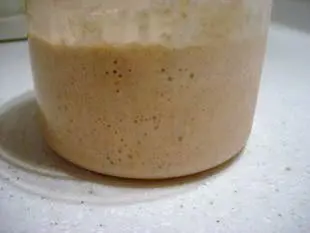
Leaven is a natural raising agent, a fermented mixture of water, flour and the microscopic yeasts which are present in the air. It's a delicate living substance, sensitive to the external environment. The recipe is around 4000 years old and dates back to the Egypt of the Pharaohs, via a beautiful history...(note: the ancient Egyptians seem not to have had exclusive knowledge of the process: in Germany evidence of cooking a fermented dough has been found from 8000 BC (the Neolithic era).
The principle is extremely simple: water is mixed with a little flour. After a few days, using the yeasts in the air, the mixture "starts". Every 3 days it must be "refreshed", i.e. by adding an equal weight of water and flour. The mix froths and bubbles, smells rather like beer, sauerkraut, or vinegar. You can then use some to make leavened bread.
The principle is extremely simple: water is mixed with a little flour. After a few days, using the yeasts in the air, the mixture "starts". Every 3 days it must be "refreshed", i.e. by adding an equal weight of water and flour. The mix froths and bubbles, smells rather like beer, sauerkraut, or vinegar. You can then use some to make leavened bread.
Last modified on: April 3rd 2020
Keywords for this recipe:For 360 g, you will need:
 180 g
180 g  180 g
180 g 

How long does it take?
Time required for this recipe:
| Preparation | Start to finish |
|---|---|
| 7 days 15 min. | 7 days 15 min. |
At what time:
- When will I finish if I start the recipe at ... ?
When should I start for the recipe to be ready at ... ? - Work this out...
Step by step recipe
Stage 1 - 5 min.
Day 1:
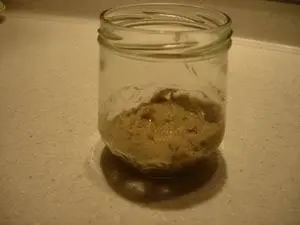
In a small pot, such as a jam jar, mix throughly 20 g flour with 20 g warm water.
You can increase your chances of success by adding the point of a teaspoonful of honey or brown sugar. It should look pasty.
You have just made the "Leaven chef", put the lid on the pot lightly so the air passes, and keep in a warm place.
In a small pot, such as a jam jar, mix throughly 20 g flour with 20 g warm water.
You can increase your chances of success by adding the point of a teaspoonful of honey or brown sugar. It should look pasty.
You have just made the "Leaven chef", put the lid on the pot lightly so the air passes, and keep in a warm place.
Stage 2 - 3 days

Leave to rest for 2 or 3 days.
Stage 3 - 5 min.
Day 3 or 4:
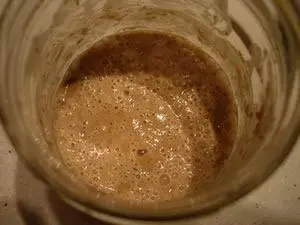
The contents of the pot might be starting to bubble, which is a very good sign!
Add to the pot 40 g warm water, mix well, then add 40 g flour. Mix thoroughly. It should look pasty again.
You have just done the "1st refreshing". Store it with the lid loosely on the pot to allow air to pass.
The contents of the pot might be starting to bubble, which is a very good sign!
Add to the pot 40 g warm water, mix well, then add 40 g flour. Mix thoroughly. It should look pasty again.
You have just done the "1st refreshing". Store it with the lid loosely on the pot to allow air to pass.
Stage 4 - 2 days
Leave to rest for 1 or 2 days.
Stage 5 - 5 min.
Day 5 or 6:
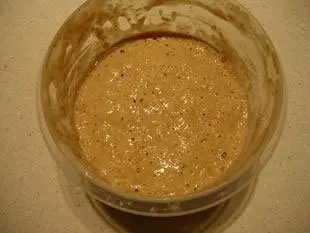
The contents of the pot should start to inflate, make bubbles, be coming alive!
Transfer the contents of the pot into a larger container (if not it will overflow). Weigh the existing leaven and add the same weight of warm water, mix well, then the same weight in flour, and mix thoroughly.
You have just done the "2nd refreshing", store it with the lid on loosely to let air to pass, or covered with a damp cloth.
The contents of the pot should start to inflate, make bubbles, be coming alive!
Transfer the contents of the pot into a larger container (if not it will overflow). Weigh the existing leaven and add the same weight of warm water, mix well, then the same weight in flour, and mix thoroughly.
You have just done the "2nd refreshing", store it with the lid on loosely to let air to pass, or covered with a damp cloth.
Stage 6 - 2 days
Leave to rest for 1 ou 2 jours.
Stage 7
Day 9 or 10:
The leaven is started, it should start to smell and to be fizzing or frothing. From now on you can start to use it for all your recipes like the new leavened bread.
When you have used some, refresh it to compensate and so on...
From now on, for a feed, weigh the existing leaven and always add its weight in water, mix well, then its weight in flour and mix again (as for day 6).
The leaven is started, it should start to smell and to be fizzing or frothing. From now on you can start to use it for all your recipes like the new leavened bread.
When you have used some, refresh it to compensate and so on...
From now on, for a feed, weigh the existing leaven and always add its weight in water, mix well, then its weight in flour and mix again (as for day 6).
Stage 8
As a summary of the leaven cycle, you can watch this short video (made with about 300 photos) which show you how leaven behaves after refreshing.
Stage 9
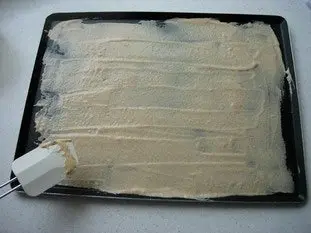
How to keep your leaven
You will have noticed that maintaining leaven requires a certain continuity, so what if you are away for several days or go on holiday?
The best method and most natural is to "dry" the leaven: After the last refreshing, wait until the leaven is at its most active again. Then spread it out with a soft spatula in a thin layer on a baking sheet.
Stage 10
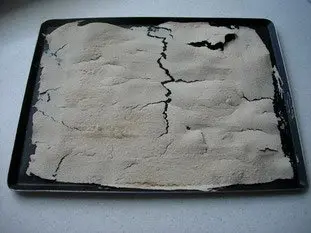
Leave to dry in the sun (or not), until it forms a crust.
Stage 11
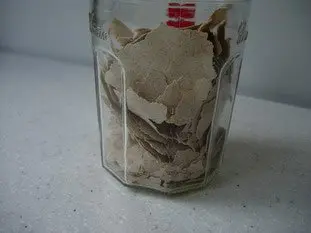
Break the crust into small pieces, and store in an airtight container. These leaven pieces will keep almost indefinitely.
To start the leaven again, put some pieces in the same weight of water, dissolve, then add some flour and it will come back to life.
To start the leaven again, put some pieces in the same weight of water, dissolve, then add some flour and it will come back to life.
Remarks
The leaven is alive and "feeds" on the exterior part of the grain so it's necessary to use "whole" or brown flours, like rye flour or wholemeal wheat flour rather than a very refined white one (like the French Type 45 or 55). It's much easier to succeed using leaven with a rye flour.
In theory a leaven is everlasting: you feed it, you use a little, and so on; but sometimes there's a drama: it "dies", and you need to start the whole process again.
Leaven is very sensitive to the environment, so it's necessary to avoid:
To store it, use a container which lets some air pass, and keep it in a warm place. The best place is normally high up, like on top of a wall cupboard in the kitchen for example.
The leaven is nourished by the outer envelope of the grain, so it's very important to use a flour with a high germ and bran content. This recipe is based on standard rye flour T170 which gives very good results. You can also consult some information on flours.
There is not one, but several leaven recipes, each one having its own little tricks, tips, additions, and peculiarities. This recipe is a "soft" or "liquid" leaven, id you want "hard" leaven you should simply double the weight of flour.
If you'd like more information, you can consult this special page on making your own bread.
Some tips:
When leaven is started, it's necessary to manage it, i.e. refresh it "when necessary" to obtain the right weight of leaven at the time you need it (typically, the day before you make leavened bread). It's not easy to succeed, especially in the at first when there's an annoying tendency to make too much, and it is very sad to have to throw some away.
Bear in mind that with each "refreshing" the leaven triples its weight, which quickly builds up. If you only make bread (like me) on Saturdays, you should ask yourself the question: how much leaven do I need to make my final leaven Friday evening? and starting from this weight (to which you should add another 30/40 g to be on the safe side), calculate for one refreshing on Wednesday and another on Monday.
All these calculations can be summarised in the following table by supposing that you need 540 g leaven on Friday evening (of course these proportions should be adapted to your needs). You should have a little left over (40g), not kneaded into the bread, which will be the base for feeding the following week and so on.
Q: A veil of liquid formed on the surface of the leaven, what can I do?
R: Your leaven has waited too long before being refreshing. Mix until homogeneous, then refresh as usual.
Q: My leaven smells strong, is it normal?
R: It means that it is "hungry", it should be refreshed.
Q: Mould has appeared on the surface of the leaven, what can I do?
R: Your leaven is dead. Start a new batch.
Q: Is it really necessary to feed the leaven before making bread?
R: Yes, if not your loaves will not rise properly.Checklist for leaven that will not start:
Your leaven won't start, it has been tragically flat for more than 3 days, or it's gone mouldy? Give up on that one, throw it out and start a fresh batch, paying attention to these essential points:
In theory a leaven is everlasting: you feed it, you use a little, and so on; but sometimes there's a drama: it "dies", and you need to start the whole process again.
Precautions:
Leaven is very sensitive to the environment, so it's necessary to avoid:
- Any contact with detergents or similar chemical products, you must rinse all utensils thoroughly.
- Low temperature, its preferred temperature is 26°C or 79°F.
- Contact with chlorinated water, you should use spring or filtered (Brita kind) water, and warm.
To store it, use a container which lets some air pass, and keep it in a warm place. The best place is normally high up, like on top of a wall cupboard in the kitchen for example.
The leaven is nourished by the outer envelope of the grain, so it's very important to use a flour with a high germ and bran content. This recipe is based on standard rye flour T170 which gives very good results. You can also consult some information on flours.
There is not one, but several leaven recipes, each one having its own little tricks, tips, additions, and peculiarities. This recipe is a "soft" or "liquid" leaven, id you want "hard" leaven you should simply double the weight of flour.
If you'd like more information, you can consult this special page on making your own bread.
Some tips:
When leaven is started, it's necessary to manage it, i.e. refresh it "when necessary" to obtain the right weight of leaven at the time you need it (typically, the day before you make leavened bread). It's not easy to succeed, especially in the at first when there's an annoying tendency to make too much, and it is very sad to have to throw some away.
Bear in mind that with each "refreshing" the leaven triples its weight, which quickly builds up. If you only make bread (like me) on Saturdays, you should ask yourself the question: how much leaven do I need to make my final leaven Friday evening? and starting from this weight (to which you should add another 30/40 g to be on the safe side), calculate for one refreshing on Wednesday and another on Monday.
All these calculations can be summarised in the following table by supposing that you need 540 g leaven on Friday evening (of course these proportions should be adapted to your needs). You should have a little left over (40g), not kneaded into the bread, which will be the base for feeding the following week and so on.
| Refreshing day | Monday | Wednesday | Friday |
|---|---|---|---|
| Leaven weight obtained after refreshing | 60g | 180g | 540g |
| Soit | 3 x 20 g | 3 x 60g | 3 x 180g |
Some common problems, and some solutions:
Q: A veil of liquid formed on the surface of the leaven, what can I do?
R: Your leaven has waited too long before being refreshing. Mix until homogeneous, then refresh as usual.
Q: My leaven smells strong, is it normal?
R: It means that it is "hungry", it should be refreshed.
Q: Mould has appeared on the surface of the leaven, what can I do?
R: Your leaven is dead. Start a new batch.
Q: Is it really necessary to feed the leaven before making bread?
R: Yes, if not your loaves will not rise properly.Checklist for leaven that will not start:
Your leaven won't start, it has been tragically flat for more than 3 days, or it's gone mouldy? Give up on that one, throw it out and start a fresh batch, paying attention to these essential points:
- Are you using organic rye flour? Organic quality guarantees you the absence of fungicides or other chemical products which could kill your young leaven.
- Are you using spring water? (chlorinated water could kill your developing leaven)
- Have you put it in a container which was carefully rinsed with hot water? (any traces of detergent could disrupt your young leaven)
- Are you keeping it in a warm place? (too low a temperature would prevent your leaven from "starting")
- Are you allowing the container to air, just covering it with a damp cloth? (It is necessary for the helpful yeasts bacteria in the air to "seed" your water and flour mixture)
Source
Henri Granier, then home made.
Nutritional information
| Whole recipe | |||
|---|---|---|---|
| Energetic value | Proteins | Carbohydrates | Fats |
| 607 Kcal or 2,541 Kj | 14 gr | 133 gr | 2 gr |
| 30 % | 6 % | 13 % | <1 % |
| Per 100 g | |||
|---|---|---|---|
| Energetic value | Proteins | Carbohydrates | Fats |
| 169 Kcal or 708 Kj | 4 gr | 37 gr | 1 gr |
| 8 % | 2 % | 3 % | <1 % |
How much will it cost?
- For 360 g : 0.45 €
Note: Be careful, these prices are only an estimate, you can consult the table of prices by ingredients used for this estimate.
Some recipes that use this recipe

Naan
Naan is a type of Asian bread made from wheat flour. This kind comes from the Punjab region of India.
175K4 3 hours 42 min.
Ocean bread
The idea for this bread was inspired by an amusing coincidence: the proportion of salt needed for good bread is 35 g of salt per litre of water, which just happens to be the exact concentration of salt in the Atlantic Ocean. So it's possible to make bread using sea water to provide all the salt...
164K 63.8 5 hours 7 min.

Mouna
Mouna is a delicious citrus-flavoured brioche from the Oran region of Algeria. It origins are much disputed, but it was no doubt inspired by a brioche brought over by Spanish immigrants from the Valencia region: the "Mona de Pascua". However, it is also amusing to remember that the citizens of Oran...
53K1 18 hours 31 min.
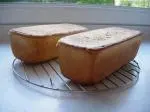
Sandwich bread
Soft and moist, almost like brioche, it can be made in a tin or mould or as a classic long French-style loaf.
340K3.9 3 hours 26 min.
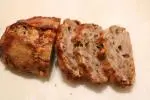
Jura bread
This speciality bread is full of all the character of the Jura: dry white wine (made with Savagnin grapes, of course), diced Comté cheese and toasted walnuts. "Jurassic bread" was is first name... The loaves can be made long, as shown here, or as small rolls. This is ideal as an aperitif snack,...
54K4.4 6 hours 9 min.
This recipe uses (among others)
 | Water: You can get more informations, or check-out other recipes which use it, for example: Couscous, Minted Melon, Couscous, Rum babas, Quince and apple compote, ... All |
 | Rye flour: You can get more informations, or check-out other recipes which use it, for example: Lumberjack turnovers, Jura bread, Benoîton, Sandwich bread, Gingerbread, ... All |
Other recipes you may also like

French croissants
In this famous and highly technical recipe from a piece of yeast-based flaky dough we are going to cut and shape ("roll") croissants.607K 24.4 2 hours 34 min. June 26th 2019
New leavened bread
This new recipe for leavened bread is simple and delicious, but needs rather long resting times. If you'd like more more information about making your own bread, look at this dedicated page.892K 34.3 7 hours December 30th 2019

Tartiflette
A personal version of a classic recipe from Savoy.585K 14.6 1 hour 27 min. September 16th 2019
Leavened bread
It might be harder to achieve good results than with traditional yeast bread, but what a flavour! It also keeps better. This recipe is designed for baking bread in a wood-fired oven but, of course, you can use the conventional oven in your kitchen.1.2M 23.8 6 hours 26 min. May 23th 2017
Pâté de campagne
Here is a personal version of the famous country pâté. It's an interesting recipe to prepare in large quantities because it keeps well and freezes easily. The secret of a good pâté is of course the ingredients, but also how it is cooked.2.0M 23.7 7 hours 54 min. October 3rd 2019
News list of cooking-ez.com
Sign up to receive the latest recipes (next batch due to be sent on 2024-05-12)
Note: We'll never share your e-mail address with anyone else.
Follow this recipe (as 23 people already do)
If you are interested in this recipe, you can "follow" it, by entering your email address here. You will then receive a notification immediately each time the recipe is modified or a new comment is added. Please note that you will need to confirm this following.
Note: We'll never share your e-mail address with anyone else.
Alternatively: you can subscribe to the mailing list of cooling-ez.com , you will receive a e-mail for each new recipe published on the site.
I'm not very easy with fruits leaven, as an aficionado of rye flour as starter for leaven, so it's difficult to give you advice about your problems. Anyway, the symptoms you describe look like a problem of strength of leaven, which occur when leaven is very young, like only 1 or two refresh. Could it be your case?
You could not compensate the altitude I'm afraid, except maybe by increasing temperature but I'm not really sure.
Look at the pictures to see how a leaving leaven is.
Yes I use organic from Whole Foods and bottled spring water. The ambient temp here is around 68 degrees.
If it is the altitude, how would I compensate.
By the way, I got the last batch to start. However once I added flour, water, and salt, after 7 hours.....nothing. I just put it in my oven which is now set on 'proof.'
How can I tell my leaven is dead?
Well it's high and it could be a reason of your problems. Here is a few ideas to help you :
- Do you really use organic rye flour, and not chlorinated water?
- Start your leaven at friends or family places, lower and warmer, and then bring it back home. Once started, it is much easier to work with it.
- Start your leaven with a pinch of yeast, just a pinch, it could be a starter sometimes.
Good luck!
E.
JB
I'm afraid there is only one solution to slow the time for the bread to go stale (assuming that you keep it in a cloth bag, not plastic one) :
You can modify a bit your recipe to add more water, the more water there is, the slower it goes stale. But unfortunately simultaneously the bread dough become more soft and more difficult to work. The goal is to find a fine and equilibrate compromise. Not so easy...
thanks for getting back to me, I've left the leaven 4-5 days before a feed and it's surviving no problem.
The first loaf I made was a bit strong for our taste so I fed the leaven half rye and half strong white flour with no problems and it gave a loaf more to our taste.
The bread goes stale a bit too quickly for us so I was wondering if you know if there is a particular reason, other than perhaps a softer crust, that fat (butter or oil) is not added in sourdough bread recipes?
Thanks
Of course, the better way is to make your own natural leaven, I'm sure with organic rye flour for the beginning you will easily succeed, come on!
I was a bit worried at first but when I did the first refreshing my leaven shot up within hours, I'll be doing the second refreshing later today so fingers crossed all goes well and I have a nice leavened loaf before the end of the week.
As I don't get through an awful lot of bread I was hoping you could tell me roughly how long I can leave my leaven before feeding it and how little I can feed it without risking it dying?
I don't want to risk my leaven dying or under-feed it but also don't want to be buying loads of rye flour just to throw it away.
Thanks very much for your recipes and your help.