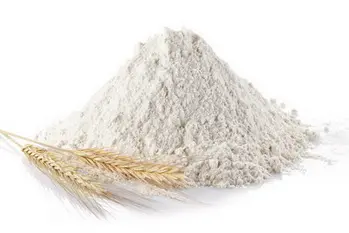
Flours classification
Type
Then a further distinction is made according to how much of the outside of the grain (bran) is left in. The purest, whitest flour (but not inevitably the best), contains only the inner part of the grain, the others contain a variable proportion of bran, right up to whole: wholemeal flour.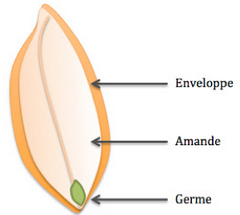
| Wheat flours | ||
|---|---|---|
| Type or "T" | Called | Usage |
| 45 | Cakes and pastries | |
| 55 | Courante | Breads and viennoiseries |
| 65 | Breads and viennoiseries | |
| 80 | Bise | Breads |
| 110 | Wheatmeal | Wholemeal and speciality breads |
| 150 | Wholemeal | Wholemeal and speciality breads |
| Rye flours | ||
| Type or "T" | Called | Usage |
| 70 | White rye | Breads |
| 85 | White rye | Breads |
| 130 | Black rye | Breads |
| 170 | Black rye | Breads |
Milling method
A third distinction can be made according to the milling method. If nothing is indicated, it means that the flour has beeen made by industrial steel mills. If it's labelled "de meule" (stone-ground) it means that the flour has been ground using real millstones which give it a special flavour (and price, which is to be expected).Organic
In addition, "organic" quality ensures that flour is of high quality, without chemical products used on the grain, or added after milling.It's so complicated...
Yes, as you can see it's a professional classification system and beginners can get lost in the jungle of numbers. To avoid that, in answer to the question "Which flour should I use?" we can summarize simply as follows:- I'm making a cake or pastry: use T45 if possible, otherwise T65 is fine
- I'm making bread: use T55 minimum, ideally T65 up to T80.
- I'm making a speciality bread: use T80 and above.
[Translator's note: Both the UK and USA use "strong" flours for breadmaking. French flour grades do not correspond exactly to UK types, but are at least fairly close the the US percentage system for "soft" flours.]
Where to buy flour?
As soon as you need a flour that's a little out of the ordinary, it's difficult to find it in the local supermarket. The best way is to look in yellow pages to find flour-mills, then call to find out if they will supply to individual customers (See about that my best addresses page). This is ofen the case now because of the widespread use of bread-making machines.You may well be able to buy a range of several different flours at cheap prices, and if you're lucky you can chat with the miller, which is always a good and instructive experience.



Yes you can, no problem at all.
Thank you in advance
I'm afraid Txx is only on French package, I think in US you have only big categories like "plain" or "whole wheat"...
I live in US, I have several flours at my home but I can't find the T symbol on the package. But some of them have more protein then others. Do you know how to figure out the T symbol by checking how much proteins flour has?
Please can you give me some names for mill
You can also use it in breads or cakes, but always in addition with classical flour and in small proportions (something like 20% of ble noir only).
Can any one help me by providing me the Specifications of Flour T-80 "de meule" (stone-ground) flour.
If you plan to cook a crust alone (in French "à blanc") it's more efficient because pastry could not rise with the weight of lentils (or anything else you use) on top.
Unfortunately I'm not easy with UK plain flour, but I guess it's a matter of "T", T45 seems to be a French exception, so you could try a T55 instead?